The model includes
-
50-resident operating model
-
Three cases:
Conservative / Realistic / Optimistic
-
Development capitalization
-
Sponsor equity
-
Public/grant capital
-
Senior debt
-
Annual revenue by source
-
Operating expenses
-
NOI
-
Annual debt service
-
DSCR
-
10-year cash flow
-
Year-10 property valuation
-
Loan balance at exit
-
Net sale proceeds
-
Levered equity IRR
-
Equity multiple
-
Resident-rent/public-subsidy sensitivity analysis
-
10-year charts
-
Assumptions and methodology/source sheet
I also incorporated
current multifamily underwriting concepts. In particular,
DSCR is generally calculated as underwritten net cash flow
divided by annual debt service; Fannie Mae currently cites
1.25x as a typical
minimum DSCR for conventional multifamily underwriting,
while certain affordable-housing programs can have more
flexible requirements.
https://mfguide.fanniemae.com/node/3781?utm_source=chatgpt.com
The three investment cases
| |
Conservative |
Realistic |
Optimistic |
| Development cost |
$10.0M |
$11.0M |
$12.0M |
| Public/grant capital |
$4.5M |
$4.0M |
$3.5M |
| Sponsor equity |
$2.5M |
$2.5M |
$2.5M |
| Senior debt |
$3.0M |
$4.5M |
$6.0M |
| Year-1 NOI |
~$383K |
~$598K |
~$693K |
| Year-1 DSCR |
~1.11x |
~1.74x |
~1.13x |
| Year-10 NOI |
~$481K |
~$811K |
~$1.0M |
| Year-10 DSCR |
~1.40x |
~2.35x |
~1.64x |
| 10-year levered IRR |
~5.0% |
~17.5% |
~23.6% |
| Equity multiple |
~1.50x |
~3.76x |
~5.74x |
My interpretation
The
Realistic Case is
the one I'd put in front of an investor first.
The $11M development
requires:
$2.5M sponsor
equity + $4.0M public/grant capital + $4.5M senior debt.
The resulting
1.74x Year-1 DSCR
gives substantially more cushion than the typical 1.25x
conventional underwriting benchmark.
https://capitalmarkets.fanniemae.com/media/8631/display?utm_source=chatgpt.com
The model then reaches approximately
17.5% 10-year
levered IRR and a
3.76x equity
multiple, assuming the modeled revenue, expenses,
debt and exit assumptions actually materialize.
Important:
those returns are
model outputs, not promises. The largest variables are
construction cost, land, achievable housing
revenue/subsidies, operating costs, financing terms and
ultimately the property's valuation.
One particularly important finding
The model reinforces
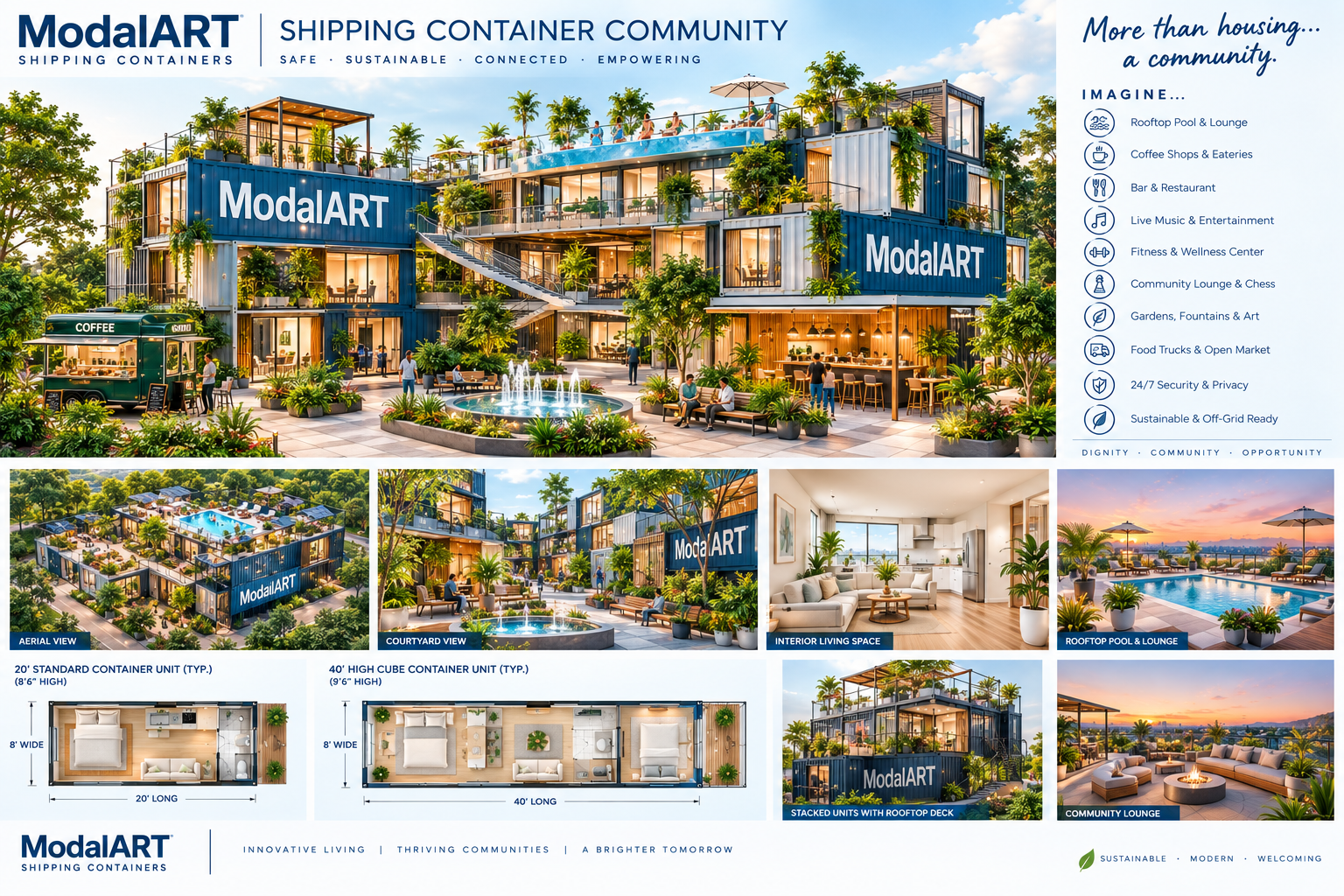
something I think is strategically important for ModalART:
The project should
not be presented as "50 shipping-container homes."
It should be presented
as a modular
affordable/supportive community development in
which the containers are the construction technology.
That opens the door to
a much more sophisticated capital stack:
Public funding →
affordable-housing financing → impact equity →
conventional/permanent debt → operating/service revenue.
Fannie Mae's current
affordable-housing programs explicitly contemplate
rent/income restrictions, housing assistance and layered
financing structures, so there may be financing avenues
worth investigating beyond a conventional commercial
real-estate loan.
https://mfguide-acpt.fanniemae.com/node/4011?section=4341&utm_source=chatgpt.com